Look, how ever you spin it, scaling your Facebook ads is hard work. It can seem like there is zero consistency in the results you get. One day your ads are absolutely crushing it, delivering an astronomical ROAS of 10, and the next day you can get as few as 2 conversions. It can frustrate the best advertisers who have years of experience under their belt.
But if you understand the inner workings of how the Facebook algorithm learns and optimizes, then you can create outstanding campaigns that generate consistently strong results.
And that’s exactly what I’m going to share with you today.
We’re going to examine how we scaled our Facebook ads to nearly half a million dollars in sales on a $35,000 budget in just five months.
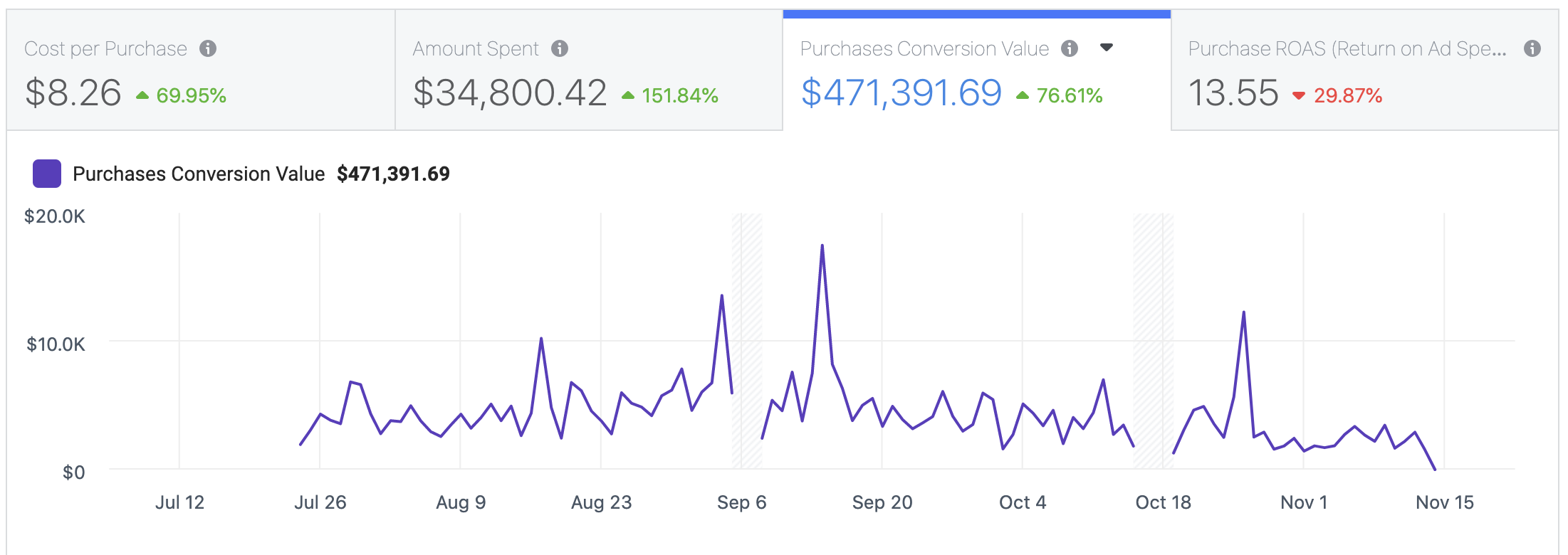
While there will always be some volatility in the performance of your campaigns, I’m here to tell you that there are steps you can take to mitigate these fluxes – hedging your ads, if you will.
Read on and you’ll learn how to set up your Facebook ads for success to ensure your ads deliver consistently solid results over the long-term. And that’s the keyword here: long-term.
So with that said, let’s dive in.
Have a strong foundation
Now before we get to the good stuff, it’s important for me to point out that the case study we are about to look at involves an account with an incredibly seasoned Facebook pixel.
So, what exactly does that mean?
Basically, this brand has spent over $50,000 in Facebook ads before we started managing the account. There is a substantial amount of data that Facebook has gathered about the brand’s existing and potential customers from its prior campaign history.
Let’s not forget that Facebook Ads is a machine-learning platform. The algorithm improves exponentially based on the amount of data it has about your audience.
And so, at the time we started managing our client’s ads, Facebook has already logged a significant number of conversion events on the pixel. I’m talking about website traffic, add to carts, initiate checkouts, purchases, and all your bottom of the funnel (BOF) events.
The point I’m trying to make here is that we are not starting from ground zero. This is a critical concept because I don’t want you thinking that we scaled from zero to half a million dollars in a few short months.
Is it possible to scale your Facebook ads to these numbers from absolutely nothing, or rather, a much smaller ad spend like $5,000? Or $10,000?
Of course it’s possible. But obviously, the biggest variable at play would be how much data you have about your existing and potential customers.
So it goes without saying that having a strong foundation is a huge success factor. In particular, what we look for is a high number of bottom of the funnel events such as purchases, checkouts initiated, add to carts, or anything that shows purchase intent.
The below screenshot shows the activity on our pixel in the last 30 days. The more data you have about your audience, the better position you are in to scale.
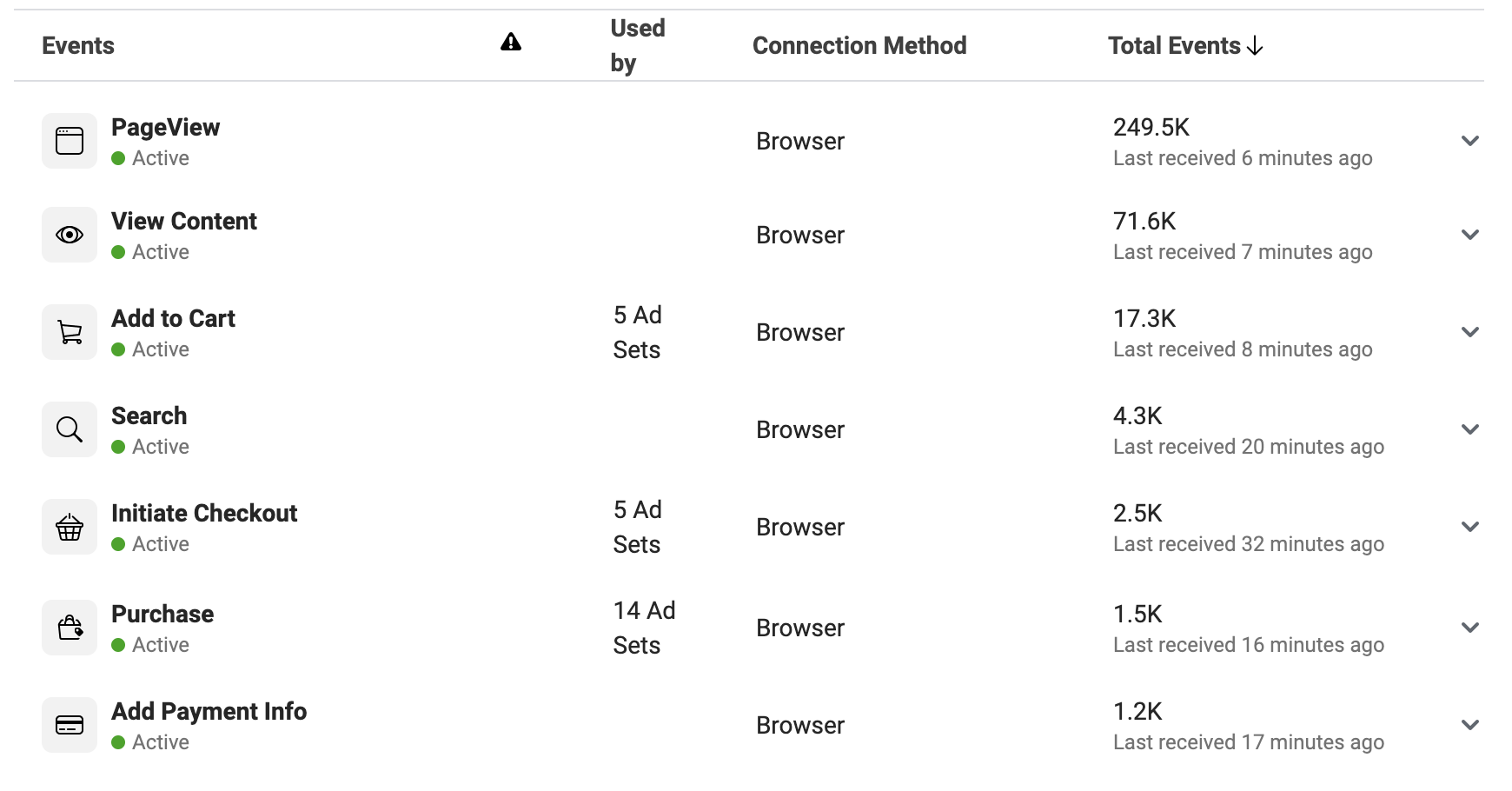
Thus, because Facebook knew enough about our core customers, we were able to scale quite easily. But more on this in a second.
Start small, and expand your audiences
Another advantage we had was a fairly decent size budget. We started with a daily budget of $200 and in the first month we built lookalike audiences (LLA) for all BOF events. So like I mentioned, these are:
- Purchases
- Add to carts
- Initiate checkouts
- Add payment info

I should also note that previously, the brand was only targeting a 2% Purchase LLA. And while this is effective, there are thousands, if not millions, more people you can reach by layering these additional LLAs. You’d be remiss for neglecting these because as you can see, the value and return on ad spend from these audiences is massive.
In some cases, and we witness this quite often, a 3% Initiate Checkout LLA is more profitable than a 2% Purchase LLA. Especially when you’re trying to scale, at some point you will max out on the number of qualified prospects within the same audience, so it’s important to expand into different, larger audiences so that Facebook can find more opportunities to drive those conversions for you.
Use a simplified account structure
We favor a simplified campaign structure as we’ve found that tends to yield the best results. Here are the key elements of our successful campaigns, which we use in many of our campaigns that are still active at the time that I’m writing this post:
- Campaign Budget Optimization (CBO)
- Automatic placements
- 2-3 ad sets per campaign
- Combination of dynamic creative and manually created ads in ad sets
- 3-5 creatives per ad set
Now, this is not an all-encompassing list, and by no means is this an end-all-be-all for campaign structures, but it’s what we’ve found to be evergreen and has produced fantastic results for us over the long-term.
Facebook has also released guidance telling advertisers that with a simplified account setup, the machine learning is able to automatically test which creative and ad placements produce the best results so that your campaigns can be optimized in real time.
Again, this isn’t to say that campaign structures using manual placements, ad set budget optimized bidding, or anything that deviates from this structure won’t work, but we have seen first-hand that simplicity is key.
The thing to remember is that constant testing will always be king, so definitely experiment with different ad types, bidding options, placements, etc to find what works best for you.
There is direct correlation between number of ad sets and creatives within your campaign, and your budget. But since you’re reading this and you’re looking to scale, I think it’s safe to assume that you’re aware of this fact.
In contrast, when you’re only able to spend $50/day, more audiences and creatives will actually work against you because your individual audiences and ads won’t receive enough spend for delivery. Which basically amounts to your ads not getting a sufficient number of impressions needed to drive the results you’re after.
In this scenario, I would limit your campaign to 2 ad sets, and no more than 3 creatives at a time.
Conversely, a larger budget means more capacity for testing: audiences, creatives, and consequently more complex account structures, if that’s your thing.
Gradually increase spend every 3 days
The tricky thing about scaling is that you must do it slowly.
Yes, I know it gets exciting when you feel like you have great momentum going, but that 6+ ROAS isn’t going to sustain itself when you triple or quadruple your budget.

Depending on how quickly you’re looking to scale, there are two ways to go about this.
Option A: Incremental budget increases on winning ad sets or campaigns
Option B: Duplicating winning ad sets or campaigns and setting a higher budget
What did we do? Both.
There is no wrong way using either method, except that option B will help you scale faster because you’re less susceptible to the potential breakdown that occurs when altering an existing ad set. You’ll see why this matters in a second.
With option B, you also need to watch out for audience overlap if you’re duplicating the same ad sets across multiple campaigns.
So that begs the question: should you kill the legacy ad sets or campaigns once you’ve duplicated and created new ones?
I get asked this all the time. My approach is to always leave whatever ad sets or campaigns running until they start to decline. Unless my ROAS really starts to take a hit, I leave them active.
As for option A, assuming your daily spend exceeds $100, I suggest 20-30% budget increases every 3 days. Keep in mind that when you bump up the spend on your ad set or campaign, this represents a significant edit that potentially resets the learning phase. During the learning phase, Facebook is exploring the best way to deliver your ads, so performance has not yet stabilized.
Pro tip: being in the learning phase isn’t necessarily a bad thing. It may look like an area of concern because Facebook likes to label it with that yellow warning icon, but if your ad set is producing solid results, then it’s nothing to worry about.
According to Facebook, an ad set exits the learning phase once there have been 50 optimization events within a week. However, if your budget is small, then it would be nearly impossible for you to generate that many conversions unless you’re spending thousands of dollars a day.
We have plenty of ad sets that are in the learning phase and continue to perform really well.
So my suggestion? Don’t freak out and think that you need to fix something if your ad sets are stuck in the learning phase. It’s another one of Facebook tactics to get you to spend more money. Don’t fall for it.
Now that we got that out of the way, you also want to make sure that your average ROAS over the last 3 days is sufficiently high – I recommend at least a 3 – before you crank up your spend.
When you dial up your budget, you will inevitably notice a slight impact on performance. But rest assured, this is absolutely normal. Let me explain why.
When you’re getting a consistently high return day after day, your ads are cruising. Adjusting any variable, including your budget, is almost as if you’re throwing a wrench in Facebook’s system, saying “here’s more money, now find me more customers.”
That’s all great and dandy. But Facebook needs time to process this change… and find those customers.
What ends up happening is that its algorithmic magic is suddenly interrupted with this additional money that it hasn’t accounted for in its existing ad set or campaign. And thus it takes a day or so to calibrate and serve your ads to a larger audience.
This is why it’s so important to not make hasty decisions when scaling. Too many times, I see people going in Ads Manager, tweaking their placements, targeting, creatives, and making all sorts of changes every single day.
Oh, maybe I should try feed placements instead.
One day later: let me try restricting the age group to 35 and up.
2 hours later: wait, let me rephrase the first line in this copy.
Stop. Doing. This.

It’s madness. Doing this will actually hurt your performance because every time you make an edit, the algorithm re-adjusts. And yep, you guessed it: you risk restarting the learning phase.
You may think that these tweaks here and there are improving performance, and they very well could be.
But you ought give it some time for those changes to take effect. Allow your ads to deliver for at least 3 days, get some real data, and then decide whether you should make further changes based on that data.
The caveat here is if you’re spending upwards of $1,000 daily, you can afford to make changes more frequently because you have enough data to change course when you know something is not working.
So it’s really a question of, “do I have enough data about how this set of ads is performing to make further edits?”
Let’s say the ads you just launched only received 1,000 impressions, a 3% CTR, but zero conversions. My intuition says that it’s still premature to go in and change anything.
Even if you are spending thousands of dollars each day, I would advise against aggressively increasing your spend everyday. With that level of spend, I would allow the ads to deliver for a minimum of 3 days so that your ads are given the chance to stabilize.
In our case, we were able to consistently increase ad spend by 20% increments, but we did so only on days when our ads were performing exceptionally well. Due to the time it takes for Facebook to recalibrate, we wanted to have a higher ROAS as a buffer to support any increases in spend.
Fortunately, the average ROAS for our client hovers around a 12, which is insanely high to begin with due to the fact that they are B2B and their average order value is $99.
While scaling, that ROAS definitely fluctuated quite a bit – which is perfectly normal – ranging from 68 on our best day, dropping to 3 on our worst day.

I realize that for some of you a 3 ROAS on a bad day would be a dream come true. In most cases, anything 3 and higher is amazing and you should definitely commend yourself for achieving that.
With that being said, it’s perfectly fine to not increase spend on a set schedule. For example, there is absolutely nothing wrong with increasing spend one day, but leaving your budget as is for the next seven days.
What’s more important is how your campaigns are doing over the average of 4+ days, and using that as a measure of whether to up the spend on a performance basis.
We’ve definitely had to scale back during the process, due to a slowdown in sales caused by inventory delays, ad fatigue, among many other factors.
Which leads me to my next point…
What should you do when performance starts to decline?
Ah, the age-old question that haunts the best of Facebook advertisers.
You’ve had incredible success up until this point. Overall ROAS has been fairly constant, frequency is at a sweet spot between 2-3, and your audiences have been crushing it so far.
Suffice to say, Facebook ads is basically printing you money right now.
Then suddenly, ROAS drops severely low. Lower than you’ve ever seen it go before. No significant changes to your targeting or bidding. Same winning creatives being delivered to your best audiences.
You try expanding your audiences and duplicating your winning ad sets, but that barely moves the needle.
You can’t figure out what went wrong.
Trust me when I say, I’ve been there. And it sucks.
You will at some point exhaust your winning ad sets and creatives, and it will seem like nothing you do can possibly get you back to the golden days when your ROAS was soaring higher than Tesla stock in Q3 2020.

Yeah, that happened.
But there is a way to revive your campaigns.
Take a deep breath and exhale: refresh your creatives.
One of the many things that businesses tend to overlook in their Facebook ads is the impact and necessity of new creatives.
Especially when scaling.
It may not seem like it, but Facebook isn’t a bottomless goldmine that funnels you with sales into infinity. There are a finite number of people on Facebook to whom your ads can be delivered.
This is not a theory. It’s a fact.
Consider this: that group of hyper-engaged shoppers on the platform have seen your ads for the seventh time already. The ones that are more willing to buy than others are no longer phased by your ads anymore… in fact, they’re scrolling right past them.
People aren’t even clicking anymore.
Wake up. It’s time to invest in some show-stopping creatives to recapture their attention.
It sounds so obvious, right?
But let’s not downplay the human capital, talent, resources (depending on the size of your team), and creativity that is required to produce a show-stopping creative.
If you have an in-house creative team that can constantly crank out amazing content for you to use in ad campaigns, you’re golden.
Got user-generated content? Even better.
Even if you don’t, you can still spend the time to evaluate your best ads so far, and ask yourself, “What made these ads great?”
What about them got people to convert?
Did you use testimonials?
Was it a carousel ad with a combination of images and video?
Did you use a super clickbait copy and headline? Let’s be honest, this always helps.
Was the offer really compelling?
For us, it was a combination of all of the above. We also used a method called social stacking in our ads to pile on as much engagement as we possibly could to create social proof, which is something you really ought to be doing if you’re not already. Hint: it’s killer for driving conversions.

Having said that, once you refresh your campaigns with some new creatives, you’ll start to see performance trending upward again. I guarantee it.
Now, how often you need to refresh your creatives is entirely contingent upon how much you spend. On a smaller budget of less than $5,000 a month, you can get away with only refreshing creatives every 2-3 months.
Conversely, if you’re a big spender with a monthly ad spend of over $50,000, you’ll need to cycle through new creatives every week or so.
On our client’s account, we have a systematic process where we rotate in new creatives every 1-2 weeks to our smallest audience: website traffic and most engaged users on Instagram and Facebook.
It’s a long-term game
At this point, I’ve mentioned a number of different techniques and strategies that have helped us generate half a million dollars in sales with less than $35,000 in Facebook ads.
It wasn’t smooth sailing at all times, and we even had to reverse scale at one point.
All this to say, the scaling process is not linear, so please don’t think that you have to continue increasing your ad budget like a runaway train. Don’t force it if the conversions aren’t there. You risk losing a lot of money by doing this, and potentially destroy your winning ad sets this way.
In that same vein, it’s also perfectly okay to reverse scale if you need to. Due to the inherent volatility of Facebook ads, you’re not always going to get consistent results every single day. And that’s perfectly normal. One day you’ll have outstanding results, maybe even a 100 ROAS. And the next day you may barely break even.
This is the nature of Facebook ads.
Which is why you should always examine performance over the average of 3-4 days.
Which brings me back to the notion of this being a long-term game.
Facebook ads rewards those who are patient, make calculated decisions based on data, and understand the importance of building a strong foundation of profitable ad sets on top of which mass scaling can then be achieved.
I hope this post was able to shed some light into how you too can scale your ads to mid 6-figures and beyond in just a few short months.
If you have any questions about scaling your Facebook ads, be sure to check out my YouTube series where I go in depth about the various strategies that we use within my agency to help our clients scale to 6 and 7-figures and beyond. There’s a lot more that’s covered there than I could possibly write in this blog post.
If you enjoyed this read, please share it with a friend or someone who may benefit from it.
If you’d like to work with my agency, drop us a message and we’ll be more than happy to help you with your campaigns. We have a proven track record of helping clients just like you to scale their social campaigns.